Level Design: Tavern Crawl
Tavern Crawl was a capstone project for my final year of school. We had 30 students total including 5 students from the Berkley School of Music.
We launched in May 2022 and by January 2023 we had 38,000 license activations and over 10,000 downloads with playtime!
We built the game using: Unreal Engine 4, Git, and Asana.
About the game:
Tavern Crawl is an action-adventure game starring Fish, a young countryside mouse who dreams of adventure. His kingdom uses alcohol as currency, fuel and as ingredients to craft useful cocktails. When the alcohol mysteriously dries up, Fish volunteers to investigate where the precious resource has gone.
How I Contributed:
Worked with an initial group of 7 as a level designer. Created the initial prototype level which was pitched to industry developers who greenlit the project.
During full development I contributed the following:
Block-outs for the opening areas of the first level.
Helped to design & block-out the Hub. Also set dressed entrances to the Toad Road and Rat Warrens areas.
Conducted feature research and collaborated with fellow designers to create gameplay features like cocktail crafting, and a Booze meter
Implemented an overhead marker mechanic via blueprints.
This showed chat bubbles and exclamation points above NPC heads to help guide the player and encourage NPC conversation.
Lessons learned:
Metrics are critical - Building a stronger set of metrics for jump distances etc. would’ve made it easier to lower our platforming difficulty.
Know when to cut content - We created too much content to deliver a consistently polished experience. I could’ve advocated for cutting out the not so unique levels and continued to polish ones that highlighted our gameplay / world.
More playtesting - We didn’t get the game in enough hands. General bugs, difficulty spikes, and issues with controls would have been more apparent with increased testing.
Opening Level Breakdown
This was my proposed design for the opening level, it was built on the foundation from our prototype. I pitched this design to team and we moved forward with it.
It focused on these covering these elements:
Introducing movement, combat, cocktail crafting
Keeping things simple to not overwhelm the player while they are learning
Ensuring good pacing by giving small breaks between learning & combat encounters.

Players originally started in front of the sewer pipe but we expanded the section for the final game.
This was done for a few reasons:
The player can better visually contextualize Fish’s story & it gave space for an intro cutscene.
Allowed me to design a larger tutorial area which better fit the narrative (Fish is re-learning his skills ahead of his journey into the sewers).
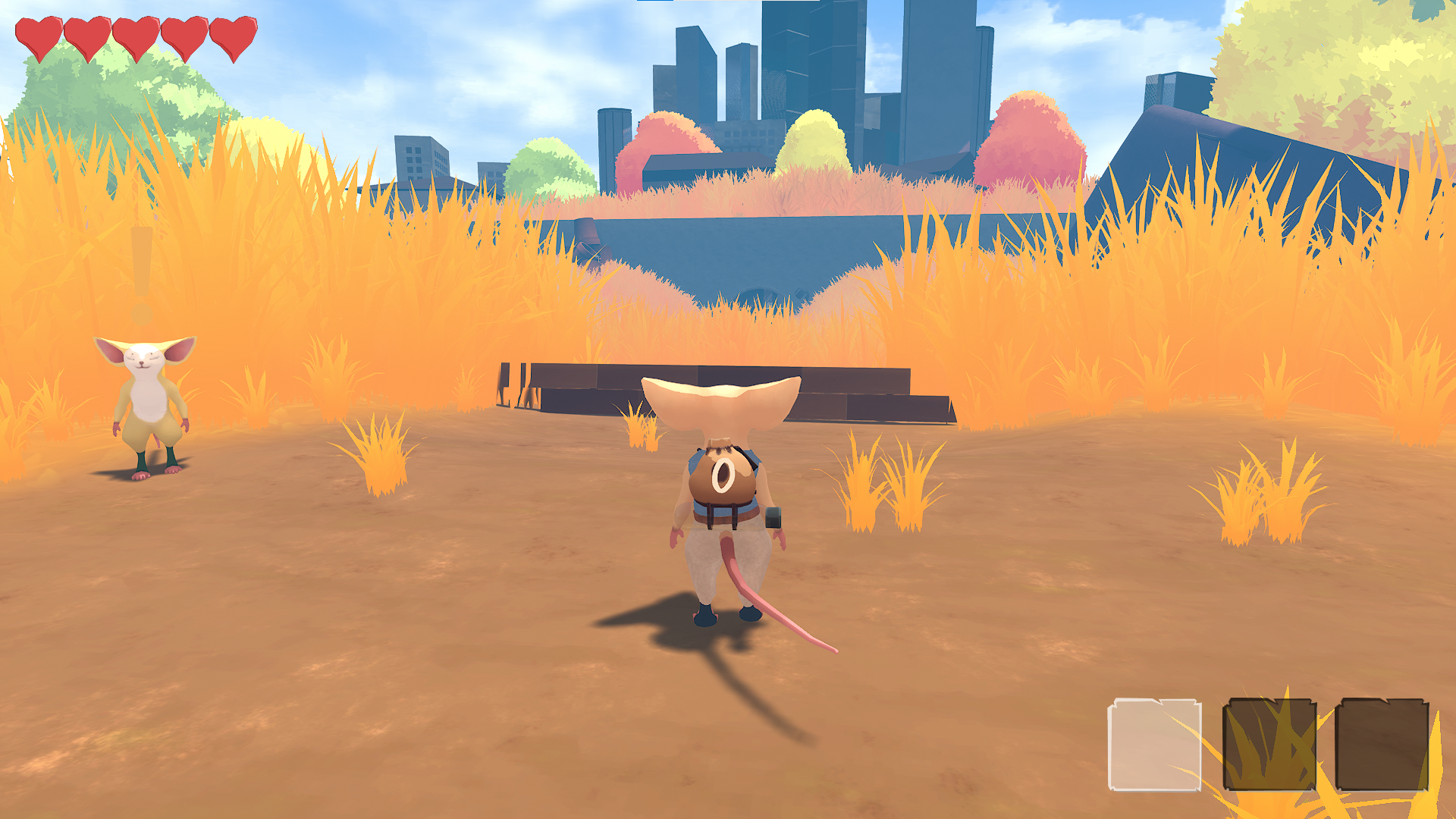
The start of the game immediately after the intro cutscene. Players see the sewers ahead and follow a short path to reach the entrance.

The main tutorial area, players learn how to use weapons, collect booze / cocktails and safely practice platforming.
Junction & Side Challenge Breakdown
After the linear tutorial area we open up exploration. I created this 4 way junction and a side challenge that connects to it.
To progress forwards the player simply continues straight, this reinforces that moving forwards = progression.
These sewer pipes are huge compared to Fish and help sell the scale of our world.
This is the first time the sewers open up so it pushes a message of “yes there is a big world to explore here!”

If the player goes left at the junction they’ll run into a platforming challenge I designed.
The entrance is a leap of faith, players can see platforms on the other side of the pipe if they look down but not much else.
The flow here is a classic One-way Valve - They fall down and need to platform back up to the top. Once at the top they jump back into a pipe and land right back where they started.
I had the following goals in mind:
It’s close to the tutorial so keep it simple and satisfying
I added lots of booze pickups and used the largest pickup size as completion reward.
Make it feel more scarier or challenging than it really was.
The pipe down is not that much larger than Fish is, we go from a really big space to a more claustrophobic, tighter space.
At the end we release this tension by landing back in the larger space.
Looking back I would change the following:
Make the overall space slightly larger so the camera has more room to breathe in certain spots.
Adjust the platforms and ropes to make it slightly easier and make sure the ropes aren’t in the camera’s way.
Use the environment more to communicate the affordance of the entrance.


Final Level & Boss Room Breakdown
The final level of the game is the royal city of Murine, where the Rat King has taken power. I created a quick slide deck to pitch this level. I wanted to cover the ideas behind the city’s sections and possible gameplay beats throughout.
The city section of the level changed quite dramatically from start to finish but the core gameplay beats remained. The level artists really nailed & elevated the whole area.
Below you can see the initial vista I blocked out vs the final version.

The initial draft of the level, the opening vista in the bottom right and the throne room entrance in the top left.


The throne room contains the game’s final boss battle:
The Rat King is slower compared to Fish but has powerful attacks.
Giving the player space to move around & cover to hide behind evens the playing field.
We ramp up the tension and difficulty over time by allowing the Rat King to destroy the pillars players hide behind.
This initial blockout didn’t change too much compared to the final version. I used can assets and a slightly lowered section of floor to create this pool of booze that the Rat King has been hoarding.

